
What is TikTok SEO? How to optimize videos for search results
TikTok is not only a platform where users scroll through videos on the For You page. It is also used to find tutorials, products, locations, reviews, and solutions to specific problems. Therefore, TikTok content needs to attract people who are exploring while also addressing the needs of users who are actively searching.
TikTok SEO helps videos establish a clear topic, match relevant queries, and become easier to discover through TikTok Search. However, search optimization is not simply about adding numerous hashtags or repeating keywords in captions. The content must still be useful, easy to understand, and aligned with the correct search intent.
What is TikTok SEO?
TikTok SEO is the process of researching, creating, and optimizing content so that videos, profiles, or products are more likely to appear when users search for a relevant keyword on TikTok.
This process usually includes:
- Researching keywords and search demand.
- Analyzing search intent.
- Selecting topics and content angles.
- Optimizing dialogue, on-screen text, captions, and hashtags.
- Building content clusters.
- Monitoring views and queries from TikTok Search.
- Updating content based on data.
TikTok SEO is not a technique that instantly pushes a video to the top of the results. It is a process that makes the topic clearer, answers questions more accurately, and generates stronger signals from viewers.
How is TikTok SEO different from going viral?
With TikTok Search, users actively enter queries such as “how to film product videos,” “outfit ideas for petite women,” or “air purifier reviews.” A video needs to match the topic, language, and search intent behind the query.
The For You page, on the other hand, focuses on discovery. Viewers are not necessarily searching for a specific topic; TikTok recommends videos based on content signals and user behavior.
A video may receive many views on the For You page but fail to maintain a strong position in search if its topic is too broad. Conversely, a video with a moderate number of views may continue receiving traffic from TikTok Search if it addresses a specific, long-term need.
SEO should not be treated as the same thing as virality because no single factor can guarantee that a video will rank first.
Why is TikTok SEO important?
TikTok SEO helps brands reach users who already have a clearly defined need and generate long-term traffic for tutorials, reviews, and question-based content. Search traffic can support efforts to increase organic TikTok views without depending entirely on trends or the For You feed.
When a channel consistently covers a particular topic, viewers can also recognize its expertise more easily and take the next step, such as visiting the profile, viewing a product, or accessing the website.

Where keywords should be optimized
Keywords should appear consistently across several elements of the video rather than only in hashtags.
Dialogue and on-screen text
Mention the main topic naturally, especially in the opening.
Example:
Here is how to write a TikTok video script for a new online shop.
The opening text should also help viewers recognize the topic immediately, such as “Three mistakes when filming product videos” or “How to optimize a business TikTok profile.”
Captions and hashtags
The caption should accurately describe the video and may include the primary keyword or a natural variation.
Example:
How to film product videos with a smartphone when you do not have a studio. This video explains how new online shops can choose suitable lighting, camera angles, and a simple background.
Hashtags support topic classification, but they are not the entire SEO strategy. Prioritize hashtags that are closely related to the content, industry, or customer need. There is no need to add numerous broad hashtags if they provide no additional context.
TikTok profile
The display name, bio, and pinned videos should help users understand what the channel is about. A clearly positioned profile can improve discoverability when users search for an account, brand, or expert within a specific field.
Step 1: Define your TikTok SEO objectives
Not every keyword serves the same objective. Businesses may use TikTok SEO to improve discoverability, establish expertise, drive viewers to the profile, generate messages, increase product clicks, or support sales.
For example, the keyword “what is TikTok Marketing?” primarily serves an informational need. In contrast, “TikTok channel management services” demonstrates clearer commercial intent.
Different objectives require different content and CTAs. A video explaining a concept may direct viewers to the next piece of content, while a commercially focused video may lead to a consultation, pricing information, or a product.

Step 2: Conduct keyword research
Use TikTok Search and Creator Search Insights
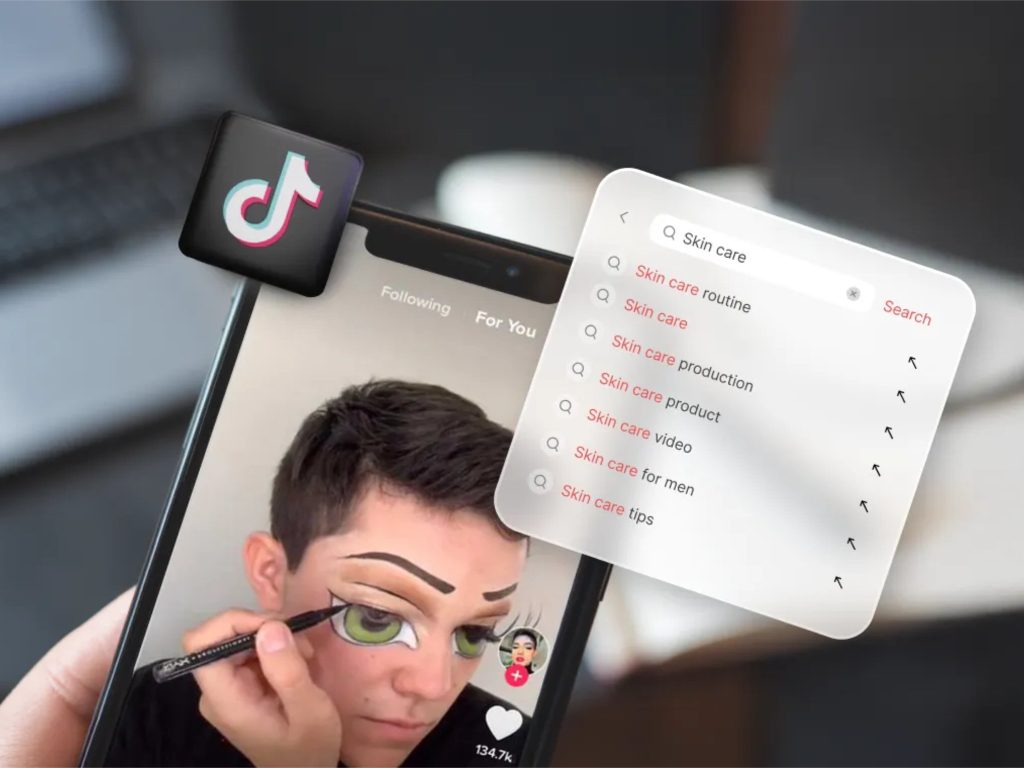
Enter a broad keyword into TikTok Search and observe the suggestions. For “TikTok scripts,” you may see:
- TikTok sales scripts.
- TikTok product review scripts.
- Faceless TikTok scripts.
- TikTok scripts for beginners.
These suggestions reveal how users express their needs. Creator Search Insights can also help identify topics, content gaps, and search performance, but businesses still need to assess whether those opportunities are relevant to their customers and products.
Analyze the current ranking results
Search for the target keyword and review the first videos shown. Note their openings, formats, content depth, on-screen text, questions in the comments, and areas that have not been explained clearly.
The objective is not to copy the highest-ranking video, but to provide an answer that is clearer, more visual, or more relevant to a specific audience segment.
Collect customer language
Useful keywords can also come from comments, messages, product reviews, sales teams, website questions, and Google Search Console. The language customers use is often more natural and more closely aligned with search intent than internal business terminology.
Step 3: Identify search intent
A keyword needs to be understood according to the purpose behind it.
- Informational: Users want to understand a concept or problem. The content should explain it clearly and avoid selling too early.
- Instructional: Users want to complete a task. The video should provide a process or checklist.
- Comparative: Users are considering different options. The content should provide evaluation criteria and suitable use cases.
- Commercial: Users are researching before making a purchase. The video should include demonstrations, evidence, and a clear CTA.
- Local: Users want to find a location or service within a particular area. The content should clearly state the location and service coverage.
Different queries require different content formats that match search intent, such as tutorials, comparisons, reviews, or demonstrations.
Search intent determines the content angle, the depth of information, and the video’s next action.
Step 4: Choose one primary keyword for each video
Each video should answer one central query. Instead of optimizing several topics at the same time, select one specific keyword, such as:
How to write TikTok hooks for sales videos.
Then naturally include related entities such as the first three seconds, viewer retention, opening dialogue, scripts, CTAs, and completion rate.
This approach creates semantic depth without requiring continuous keyword repetition.
Step 5: Write the script according to search intent
A strong SEO-focused video should answer the question quickly and accurately. Its structure may include:
- Confirm the problem.
- Provide a direct answer.
- Explain the steps or criteria.
- Illustrate the answer with an example.
- Summarize the result.
- Present an appropriate CTA.
For example, for the keyword “how to choose a microphone for TikTok”:
Hook:
If you film TikTok videos in a small room, do not choose a microphone based only on price.
Main content:
Check the distance between the speaker and the phone, the level of background noise, and whether you are filming one person or several people.
Example:
A lavalier microphone is suitable when the speaker needs to move around. A directional microphone is more appropriate when the camera remains stationary.
CTA:
Save these three criteria before choosing a microphone.
The video must provide a practical answer rather than simply repeating the keyword and then introducing a product.
Step 6: Optimize content quality and retention
Keywords help define the topic, but content quality determines whether viewers continue watching.
Check:
- Does the opening address the question immediately?
- Does the video deliver what it promises?
- Are any sections repetitive or unnecessarily indirect?
- Do the visuals support the spoken content?
- Are the examples specific enough?
- Is the text easy to read?
- Is the CTA relevant?
A video that uses the correct keyword but has poor retention may still perform badly. Conversely, useful content with an unclear topic may miss potential search traffic.
Step 7: Build topic clusters
Do not create only one video for a broad keyword. For the topic of TikTok SEO, a business could develop:
- What is TikTok SEO?
- How to research TikTok keywords.
- How to use Creator Search Insights.
- How to write TikTok captions.
- Are hashtags still important?
- How to analyze traffic from TikTok Search.
- Why does a video not appear in search results?
- TikTok SEO for local businesses.
These videos can be connected through verbal references, playlists, pinned videos, or video replies to comments to increase topical coverage.
Step 8: Publish and monitor signals
After publishing, respond to comments, create follow-up videos based on new questions, direct viewers to related content, and monitor search queries.
Do not purchase views, generate fake engagement, or fill comments with keywords. These practices distort the data and do not help businesses understand genuine customer demand.
Step 9: Measure TikTok SEO performance
Do not evaluate performance only by checking whether the video ranks first because the order of search results can change depending on the time and the searcher’s context.
Track:
- Views generated through search.
- Queries that lead users to the video.
- Watch time and completion rate.
- Relevant saves, shares, and comments.
- Profile visits and new followers.
- Product clicks, website visits, messages, or orders.
Prioritize search data from the account itself rather than relying on manual ranking checks.
How to diagnose an underperforming SEO video
The video does not appear for the target query
Check whether the topic is clearly mentioned, whether the on-screen text and caption are consistent, whether the video genuinely answers the query, and whether the keyword is too broad.
The video receives impressions but few views
The first frame, opening text, or content promise may not be compelling enough. Make the topic more specific and communicate the benefit earlier.
The video receives views but has low retention
The hook may be relevant, but the main section may be too slow or fail to provide the expected answer. Remove unnecessary introductions, present the answer earlier, and add a demonstration.
The video receives traffic but generates no conversions
Check whether the query attracts the right potential customers, whether the CTA is appropriate, whether the profile has clear positioning, and whether the product or website is directly relevant to the video.
TikTok SEO is not only about generating traffic. Businesses also need to evaluate the quality of the search demand.
TikTok SEO and TikTok Shop SEO
TikTok video SEO focuses on topics, search intent, dialogue, on-screen text, captions, hashtags, content clusters, and search performance.
TikTok Shop SEO also involves product names, categories, images, descriptions, attributes, pricing, reviews, inventory, and product-linked videos and livestreams.
Therefore, video optimization cannot replace the entire process of optimizing the storefront and product pages.
Common TikTok SEO mistakes
Common mistakes include focusing only on hashtags, selecting keywords that are too broad, keyword stuffing, treating SEO as the same as virality, copying ranking videos, and failing to build topic clusters.
Another mistake is looking only at total views without monitoring queries, watch time, or actions taken after viewing. TikTok SEO is still about creating content for people; videos need to be useful, easy to understand, and appropriate for the platform.
Video optimization checklist before publishing
- The video has one clear primary keyword or topic.
- The search intent has been identified.
- The hook goes directly to the problem.
- The keyword appears naturally in the dialogue.
- The opening text accurately describes the topic.
- The caption provides additional context.
- The hashtags are relevant.
- The content fully delivers on its promise.
- The example or demonstration is sufficiently specific.
- The CTA aligns with the objective.
- The video belongs to a topic cluster.
- The profile reflects the correct positioning.
- There is a plan for monitoring search data.
TikTok SEO is the process of researching user needs, identifying the correct search intent, creating better answers, and making adjustments based on data. When keywords, dialogue, visuals, captions, and content quality are aligned, videos have a better chance of reaching the right audience.
Long-term value does not come from adding as many hashtags as possible, but from building a channel that becomes a trusted source of content for the topics customers are actively searching for.
Read next: Want to turn individual search-focused videos into a structured content system? Learn how related topics, profile positioning, and consistent publishing can build topical relevance for a business TikTok channel.