
How to increase TikTok views organically, reach the right audience, and grow sustainably
Increasing TikTok views is not simply about making the view count higher. For creators, online shops, and businesses, views are only valuable when a video reaches the right people, holds their attention, and guides them toward an appropriate action, such as watching more content, visiting the profile, following the channel, sending a message, or making a purchase.
A video with many views may still fail to generate customers if it attracts the wrong audience. Conversely, a video with a moderate number of views can still be valuable when it reaches the right people.
To increase TikTok views sustainably, you need to focus on three factors: choosing the right topic and audience, creating content that is clear enough to keep them watching, and then using data to improve your next videos.
What does it mean to increase TikTok views organically?
Increasing TikTok views organically is the process of expanding viewership through the platform’s organic distribution capabilities rather than buying views, using view-boosting tools, or generating fake engagement.
Organic views can come from the For You page, TikTok Search, followers, profiles, shared videos, Duets, Stitches, playlists, or viewers returning to the channel.
No single tactic can guarantee that a video will be distributed widely. A more reliable approach is to create relevant content and improve the audience’s genuine response.
Why do TikTok videos receive few views?
Low views do not necessarily mean that an account’s reach is being suppressed. Videos often receive few views because the topic is not relevant enough, the opening is too slow, the hook does not match the main content, or the viewing experience is poor.
Trends, hashtags, or overly broad topics can also attract the wrong audience. Content that does not meet the platform’s standards may have its distribution restricted.
Instead of immediately concluding that the account has been limited, examine each layer of the video: the topic, hook, retention, engagement quality, and actions taken after viewing.
1. Identify the right audience and needs
A common mistake is setting the goal of attracting “as many viewers as possible.” A channel that grows sustainably needs to attract people who are likely to remain interested in future content.
Before filming, clearly define who the primary viewers are, what problem they are experiencing, what they usually search for, what evidence they need, and what they should do after watching.
For example, “people who want to create TikTok content” is too broad. It could be narrowed down to new shop owners filming their own product videos, affiliate creators who do not know how to write scripts, or marketing employees managing business accounts.
The clearer the audience is, the more specific the hook, examples, and CTA can become, improving both retention and follower quality.
2. Choose topics based on genuine demand
A video has a better chance of receiving more views when its topic addresses a question or situation that viewers immediately recognize.
Ideas can come from comments, messages, sales teams, product reviews, TikTok Search, Creator Search Insights, competitor content, and Google Search Console.
Instead of choosing a broad topic such as “TikTok tips,” focus on a specific problem, such as “why do videos get many views but no orders?” or “how to film product videos without anyone assisting you.”
Specific topics help viewers recognize that the content is relevant and improve its chances of appearing in TikTok Search.
3. Communicate the value immediately
The opening should quickly show viewers what problem the video addresses, who it is for, and what benefit they will receive by continuing to watch.
Some opening approaches include:
- Highlight a mistake: “Your videos are struggling to gain views because they start this way.”
- Present a result: “Here is how I turned one topic into seven TikTok videos.”
- Identify the audience: “If you film videos for your shop by yourself, prepare these three shots.”
- Challenge an assumption: “Posting more frequently does not necessarily increase your views.”
- Use visuals: Show a before-and-after result, demonstrate a feature, or display the mistake in the first frame.
A hook does not need to be shocking. It needs to be clear, relevant to the right audience, and directly connected to the content that follows. If the main section does not fulfill the promise, viewers may still leave even when the opening is compelling.
4. Focus on one idea and remove unnecessary content
A broad topic usually cannot be explained effectively in one short video. Instead of presenting the entire process of building a TikTok channel, divide it into videos about positioning, content pillars, profile optimization, hook writing, retention analysis, and CTA selection.
Each video only needs to answer one clear question and can later be developed into a series. The script should also remove lengthy greetings, unnecessary transitions, repeated information, and overly long CTAs.
Instead of saying:
Hello everyone, today I am going to share several ways to help your TikTok videos receive more views.
Go straight to the point:
To increase TikTok views, check these three points before posting.
The video should be long enough to fulfill its promise but should not contain unnecessary sections. Read the script aloud and ask whether every sentence contributes to the message.
If viewers leave during the opening or middle of the video, review and improve your TikTok video script before changing the entire topic.
5. Combine dialogue with supporting visuals
A person speaking continuously to the camera can still create effective content, but maintaining attention becomes more difficult when the visuals remain unchanged and provide no illustration.
You can add B-roll, screen recordings, product demonstrations, before-and-after images, summary text, camera-angle changes, or real-world examples.
Videos should use a vertical frame, clear visuals, easy-to-hear audio, and place important information within the safe zone. Every visual change should support the information being presented.
6. Optimize for TikTok Search and maintain clear positioning
Some views may come from users who are actively searching. Therefore, content should not depend solely on the For You page.
To generate views beyond the For You feed, optimize content for TikTok Search around specific audience questions.
Each video should focus on one specific query and communicate the topic through keywords in the dialogue, opening text, caption, relevant hashtags, and content that genuinely addresses the search intent.
Instead of using a generic caption such as “sharing some experience #fyp #viral,” you could write:
How to increase TikTok views by improving your hook, watch time, and topic relevance.
There is no need to repeat the keyword several times. Clarity and the ability to meet user needs are more important than keyword or hashtag stuffing.
A channel should maintain approximately three to five consistent content pillars. Trends should only be used when they suit the audience and positioning. One viral video does not guarantee growth for the entire channel.
7. Encourage genuine engagement
Valuable engagement does not come from generic questions but from inviting viewers to share relevant experiences or problems.
Instead of asking, “Does everyone agree?”, ask:
Which part of your videos usually loses the most viewers?
You can reply to comments with videos, pin valuable questions, develop follow-up content, or encourage viewers to save a checklist. Genuine engagement also provides data for discovering new content ideas.
8. Post consistently without chasing volume or universal posting times
There is no fixed posting frequency or time that guarantees higher views for every channel.
Consistent posting helps test topics and build a content library, but posting too much without analyzing the results will only repeat the same mistakes. Choose a frequency that allows you to maintain quality and still have time to review the data.
For posting times, test two or three time slots that match your audience’s routine, compare the results over several weeks, and retain the more consistent options. Posting time may support initial distribution, but it cannot rescue a weak video.
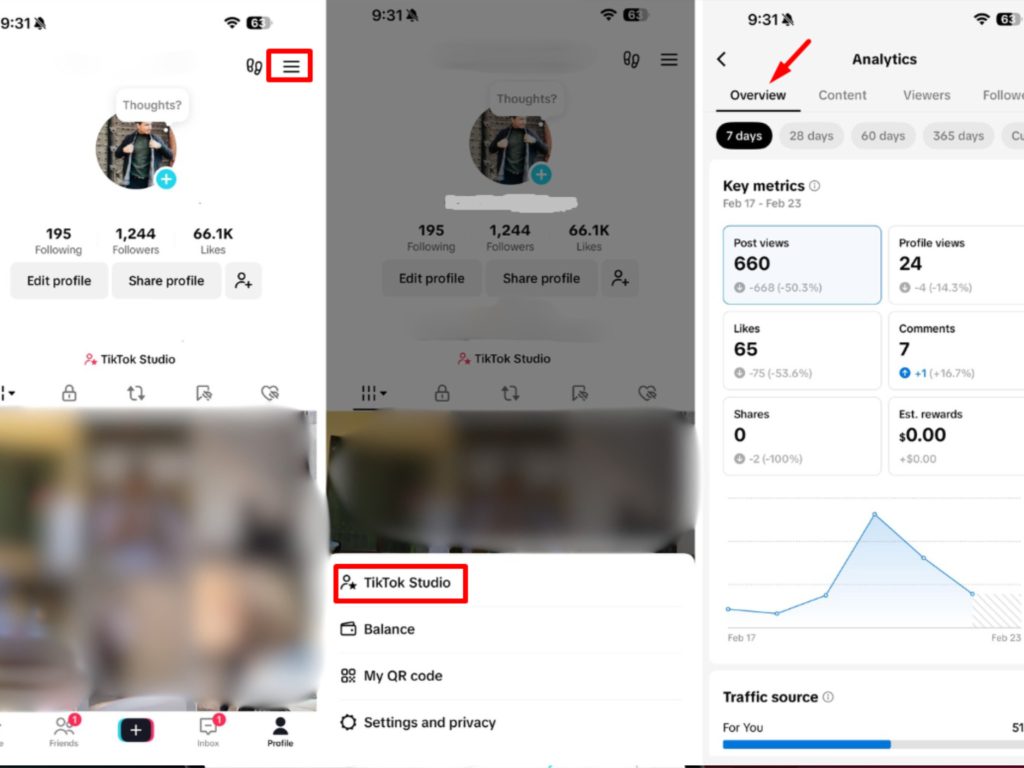
9. Analyze data in separate layers
Do not look only at total views. Analyze each video across four layers.
Ability to attract attention
Do viewers stop scrolling? Is the first frame clear? Does the hook target the right audience?
Ability to retain viewers
At which point do viewers leave? Does the main section fulfill the promise? Is any section too long?
Engagement quality
Are the comments relevant to the topic? Is the video saved or shared? Are viewers asking in-depth questions?
Next actions
Does the video generate profile visits, new followers, product clicks, website visits, or messages?
A video with many views but few actions may be effective for awareness, but it may not support customer acquisition or revenue objectives.
10. Develop strong topics and expand distribution
When a video performs well, do not abandon the topic to search for a completely new idea. You can create another version with a different hook, a second part, a more in-depth video, a video reply to a comment, a case study, or a checklist.
For example, a video about “three mistakes that cause videos to receive few views” could be expanded into how to fix a weak hook, how to analyze retention, how to shorten the introduction, or why high views do not generate followers.
Duets, Stitches, UGC, and creator collaborations can help reach new communities. Prioritize audience relevance and content quality rather than follower counts alone.
Videos can also be shared on other platforms when adapted to the appropriate context. Promote and TikTok Ads should only be used when the organic content has already shown positive signals and the conversion destination is ready. Advertising can buy distribution, but it cannot buy content quality.
Should you buy or artificially boost TikTok views?
Fake views should not be used as a growth strategy. Artificial views do not bring relevant viewers, genuine engagement, or customers.
They also distort the data, making it difficult to identify which topics, hooks, and formats are actually effective. A sustainable channel requires genuine audience responses, not a high displayed number that creates no real value.
How to handle a TikTok video with few views
First, do not delete the video immediately. Check whether the content violates any rules, has been restricted, or encountered an upload error.
Next, identify which layer has a problem:
- It does not attract attention: revise the hook and first scene.
- It does not retain viewers: shorten the main section.
- It receives little engagement: review the value and the question being asked.
- It does not convert: revise the CTA, profile, or destination.
Create a new version by changing one clearly defined element, such as the angle, hook, information order, example, length, or CTA. Do not repost the exact same video and expect a different result.
Finally, compare videos that share the same objective. Sales videos and view-generating videos should not be evaluated solely by their total view counts.
Metrics to track
| Objective | Metrics |
| Attract attention | Views, new viewers, views from the For You page |
| Retention | Watch time, completion rate, video drop-off points |
| Engagement | Comments, shares, saves |
| Channel growth | Profile visits, new followers |
| TikTok SEO | Views and queries from search |
| Sales | Product clicks, additions to cart, orders |
| Customer acquisition | Messages, form submissions, website visits |
There is no universal view count that determines whether all content has succeeded or failed. The most important metric depends on the video’s purpose.
A 30-day roadmap for increasing TikTok views
Week 1: Build the foundation
Define the audience, choose three content pillars, collect real customer problems, optimize the profile, and select formats that are easy to produce.
Week 2: Run experiments
Test different openings, publish tutorials, mistake analyses, and comparisons, monitor the initial response, and record questions from the comments.
Week 3: Develop positive signals
Recreate effective topics, build series, reply to comments with videos, and add demonstrations or case studies.
Week 4: Evaluate performance
Compare the content pillars, identify effective hooks, evaluate follower quality and profile visits, and then remove formats that consume substantial resources but deliver poor results.
The objective of the first 30 days is to identify repeatable topic groups and presentation methods, not to force the channel to produce a video with millions of views.
Increasing TikTok views organically and sustainably does not depend on using as many hashtags as possible, posting at one fixed time, or constantly following trends. The foundation of growth is reaching the right people, solving the right problems, and creating videos that are clear enough to keep them watching.
Begin with a specific topic, a relevant hook, the removal of unnecessary content, and visuals that illustrate the information. After publishing, analyze the video’s ability to attract attention, retain viewers, generate engagement, and encourage the next action rather than looking only at total views.
When topics showing positive signals are developed into series and improved through data, the channel can generate more consistent views, attract the right community, and create meaningful value.
Read next: Want to turn isolated video ideas into a repeatable growth system? Learn how to develop a balanced TikTok content system that attracts viewers, builds trust, and supports conversions.