
How to build a TikTok channel for your business from scratch
Building a TikTok channel for a business involves more than creating an account and posting videos consistently. The channel needs a clear objective, positioning, content system, and conversion destination. Without these foundations, a business may generate views while attracting the wrong audience, struggle to maintain content production, and remain unable to determine how TikTok contributes to its operations.
A well-structured channel can help a brand reach new customers, explain its products, demonstrate its capabilities, and direct viewers to TikTok Shop, a website, or a consultation team.
What does building a business TikTok channel involve?
It is the process of setting up, developing, and operating an account that represents a brand with the aim of reaching customers, communicating value, and producing measurable marketing results.
The work includes defining objectives, researching customers, establishing positioning, optimizing the profile, designing content pillars, producing videos, engaging with the community, and analyzing data.
Unlike a personal account, a business channel must also ensure account ownership, brand consistency, approval procedures, and coordination between marketing, sales, and customer service teams.
Step 1: Define the channel’s objective and role
Before considering the account name or first video, the business needs to answer one question: What result is this TikTok channel being created to achieve?
Before producing the first videos, the business should develop a TikTok marketing strategy connected to measurable objectives.
The objective may be to increase awareness, reach a new market segment, generate demand, attract potential customers, drive traffic to a website, sell through TikTok Shop, support recruitment, or create assets for advertising.
The objective should be connected to specific metrics and a defined timeframe. For example:
Within 60 days, publish 24 videos across four content pillars, generate 3,000 profile visits, and produce at least 200 website clicks.
“Millions of views” should not be the only objective. A high view count creates limited value when most viewers do not belong to the customer segment the business needs to reach.
The channel also needs a clear role in the customer journey:
- Build awareness: Reach people who are unfamiliar with the brand through common mistakes, questions, situations, or tips.
- Build trust: Demonstrate capabilities through product demonstrations, case studies, processes, behind-the-scenes content, and customer feedback.
- Drive conversions: Direct viewers to a product, website, message, form, or consultation booking page.
If the destination after the video is not clearly defined, the channel may generate engagement without contributing significantly to business results.
Step 2: Research customers and content gaps
Customers should not be described solely by age, gender, and location. Businesses need to understand their problems, language, viewing behavior, and purchasing barriers.
Clarify the difficulties customers are experiencing, the results they want to achieve, the questions they usually ask before buying, the evidence they need, and the phrases they use to search for content.
Data can come from TikTok Search, comments, messages, product reviews, sales teams, competitor content, Google Search Console, and customer interviews.
The collected information should be converted into insights that can be developed into tutorials, mistake analyses, or case studies.
When analyzing competitors, the objective is not to copy videos with high view counts. Observe their positioning, topics, formats, hooks, CTAs, and questions in the comments.
A content gap may exist when competitors only advertise products, explain knowledge in a difficult way, provide insufficient demonstrations, or fail to serve a specific customer segment. A business does not need to create a completely new topic; providing a clearer and more practical answer may already create meaningful differentiation.
Step 3: Define the positioning and content promise
Positioning helps viewers understand who the account is for, which problems it addresses, and why they should follow it.
Strong positioning should answer four questions:
- Which audience does the channel serve?
- Which problems does the channel focus on?
- What value will viewers receive?
- How does that value relate to the business?
Example:
Sharing practical sales-content methods that small shops can implement easily.
Or:
Explaining technical rubber solutions through visual examples for engineers and procurement teams.
Based on this positioning, the business can develop a content promise: what viewers can expect when they follow the account. The promise should be specific enough to create differentiation while still allowing the channel to cover multiple topics related to its products or services.
Step 4: Set up the account and protect ownership
A TikTok account is a digital business asset. Complete control should not depend on an employee’s or agency’s personal email address or phone number.
Use an email address associated with the company domain, a phone number managed by the business, a password stored in a password manager, and two-factor authentication. A handover process should also be established for personnel changes.
If several employees or partners are involved, assign access according to roles instead of sharing the password directly. This structure reduces the risk of losing the account or being unable to revoke access when a working relationship ends.
Step 5: Optimize the business TikTok profile
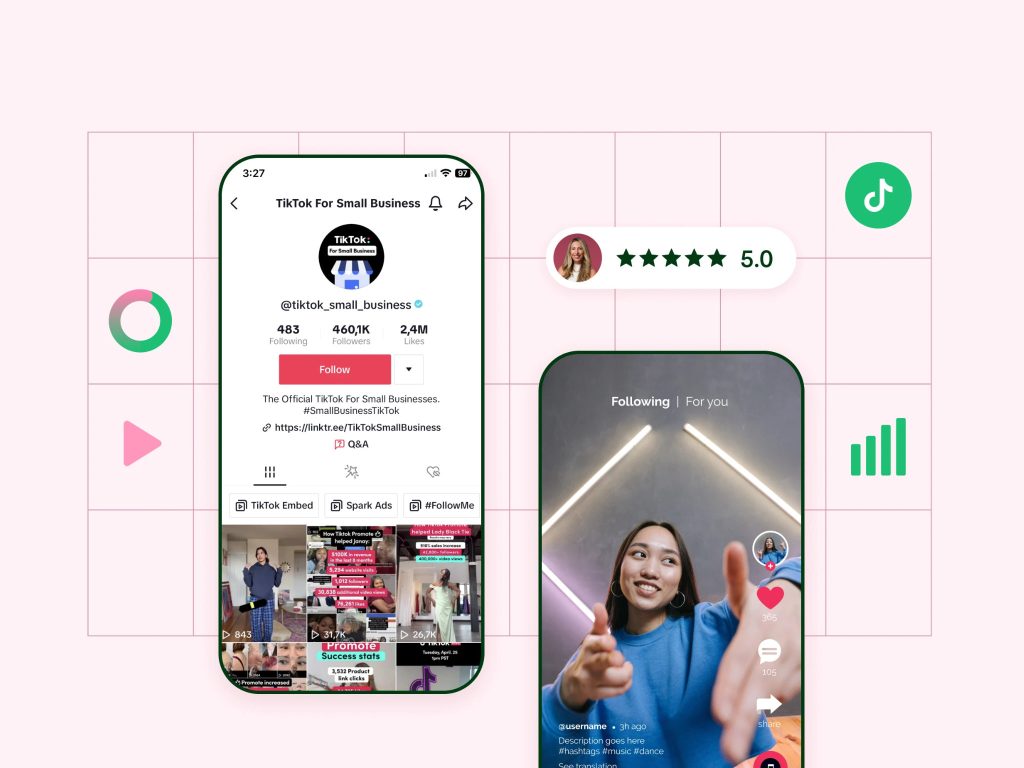
The profile is where viewers evaluate the brand after a video captures their attention. It should help them understand who the business is, what value it provides, and which action they should take.
The display name should include the brand name and may also mention the business category. The username should be concise, easy to read, and consistent with the website and other social media accounts.
The profile image should remain clear when displayed at a small size. The bio should describe a benefit instead of using only a generic slogan.
Instead of:
Quality builds the brand.
Write:
Practical tips for choosing and using household products in small kitchens.
The profile link should match the objective: TikTok Shop for sales, a landing page for lead generation, a website for information, or a booking page for service consultations.
Pin a video that introduces the channel’s positioning, a video that demonstrates expertise or supporting evidence, and a video that directs viewers to the primary product or service.
Step 6: Build a content system
A new channel should begin with approximately three to five content pillars. These pillars should sit at the intersection of what customers care about, what the business is qualified to discuss, and what can be connected to business objectives.
For example, a website design company could choose website mistakes, user experience, processes, case studies, and costs. A household goods shop could focus on usage tips, comparisons, real-life situations, quality testing, and behind-the-scenes content.
After choosing the content pillars, select effective content formats for TikTok based on whether the video needs to attract, educate, or convert.
In addition to the topic, every video should have one specific role:
- View-generating content: Common mistakes, situations, tips, comparisons, or frequently asked questions.
- Trust-building content: Demonstrations, case studies, processes, behind-the-scenes content, or before-and-after results.
- Sales content: Need-based solutions, objection handling, product-linked videos, livestreams, or consultation CTAs.
Do not expect one video to attract a broad audience, provide an in-depth explanation, tell a story, and sell at the same time. Each video should have one primary function so that its message remains clear and its performance can be measured more easily.
Step 7: Choose formats and brand representatives
A business does not need to use every available format. Select the formats that suit the industry and available resources, such as direct-to-camera videos, voice-overs, demonstrations, screen recordings, video replies to comments, interviews, behind-the-scenes content, or before-and-after videos.
The person appearing in the content may be the business owner, a technical expert, a salesperson, a presenter, a creator, or a real customer.
The representative should suit the channel’s role. For technical products, an internal expert usually builds more trust than a presenter who is simply reading a script.
Step 8: Build an idea library and production workflow
Content ideas should not be developed only on the day of filming. Businesses should maintain a content library containing customer problems, content pillars, video roles, keywords, hooks, main points, evidence, CTAs, and production status.
A basic script may include:
- Hook: Help viewers recognize the problem.
- Context: Explain why the problem matters.
- Main content: Provide the answer or solution.
- Evidence: Add a demonstration, data, example, or experience.
- CTA: Direct viewers toward the next step.
The production workflow may move from collecting insights, selecting topics, writing scripts, obtaining approval, batch filming, editing, checking brand and copyright requirements, publishing, and then analyzing feedback.
Responsibilities need to be clearly assigned: who manages strategy, verifies technical information, writes scripts, films and edits videos, manages comments, and analyzes data. Bottlenecks often occur because approvals are slow or no one has been assigned final responsibility.

Step 9: Optimize for TikTok Search and engage with the community
A business channel should not depend solely on the For You page or trends. Each video can focus on a specific query and communicate the topic through dialogue, on-screen text, captions, relevant hashtags, and content that genuinely answers the question.
Instead of a broad topic such as “sales tips,” develop topics such as “how to write hooks for product videos,” “why do videos receive many views but no orders?” or “how to optimize a business TikTok profile.”
Do not stuff keywords or use numerous broad hashtags. The objective is to clarify the context and address the search need accurately.
Before publishing, check the visuals, audio, text, caption, cover image, CTA, links, and attached products. After publishing, respond to valuable comments, record recurring questions, and turn them into new videos.
There is no universal best posting time for every channel. Test several time slots that suit the target customers, and then adjust them based on the account’s own data.
Step 10: Measure and improve the channel
Not every video should be evaluated based on views. The metrics to monitor depend on the objective:
| Objective | Priority metrics |
| Awareness | Reach, views, new viewers |
| Retention | Watch time, retention, completion rate |
| Engagement | Comments, shares, saves |
| Channel growth | Profile views, new followers |
| Demand generation | Product-related questions, messages |
| Traffic | Clicks, CTR, landing page visits |
| Sales | Product clicks, additions to cart, orders |
Review videos with positive signals every week. Each month, evaluate the content pillars, formats, hooks, and conversion journey.
When a topic receives a strong response, develop it into a series, change the hook, add examples, or present it through another format. Do not change the entire strategy after only a few videos.
A 30-day channel-building roadmap
Week 1: Build the foundation
Define objectives, research customers, analyze competitors, select the positioning, establish account ownership, optimize the profile, and determine the content pillars.
Week 2: Prepare the content
Create a library of 20–30 ideas, select three to five formats, write scripts, batch film the videos, and complete the approval workflow.
Week 3: Run a publishing test
Publish view-generating and trust-building content, test several hooks, monitor retention, saves, and comments, and record viewer questions.
Week 4: Optimize and expand
Recreate topics showing positive signals, build series, add sales content, pin important videos, and adjust the bio and CTA.
The first month is a period for learning from data. The business does not need to force the channel to go viral or generate substantial revenue immediately.
Mistakes to avoid
Common mistakes include publishing videos before defining the positioning, producing only promotional content, following irrelevant trends, depending on one employee, and failing to protect account ownership.
Some businesses publish frequently without analyzing performance, focus only on follower counts, or change their strategy too quickly. Profile views, saves, purchase-related questions, clicks, and revenue may be more important than the number of followers.
Do not purchase followers to create initial credibility. Irrelevant followers do not generate meaningful engagement or conversions and make the channel’s data less accurate.
Building a TikTok channel for a business should begin with clear objectives, customer understanding, and positioning rather than trends or video volume. When account ownership is protected, the profile is optimized, and content is organized according to clearly defined pillars and roles, the business gains a more stable production foundation.
By combining TikTok Search, community engagement, and data analysis, the channel can gradually reach the right customers, build trust, and generate sustainable conversions.
Read next: Want your business videos to reach people who are actively searching for relevant solutions? Learn how to optimize business videos for TikTok Search through clearer topics, search intent, scripts, captions, and content clusters.