
What Is TikTok Ads? A Beginner’s Guide to Running TikTok Advertising Campaigns
TikTok Ads allows businesses to deliver content, products, or services to relevant groups of users through paid distribution. However, running ads involves more than selecting a video, entering a budget, and waiting for orders. Performance also depends on the campaign objective, content quality, audience, landing page, and measurement system.
An advertisement with many views does not necessarily generate revenue. Conversely, a campaign with a higher impression cost may still be effective if it reaches the right customers and produces valuable conversions. Beginners need to understand how TikTok Ads works and optimize the entire customer journey rather than focusing only on clicks.
What Is TikTok Ads?
TikTok Ads is TikTok’s paid advertising system, allowing businesses to distribute videos to different user groups based on campaign objectives, audience characteristics, behaviors, and platform signals.
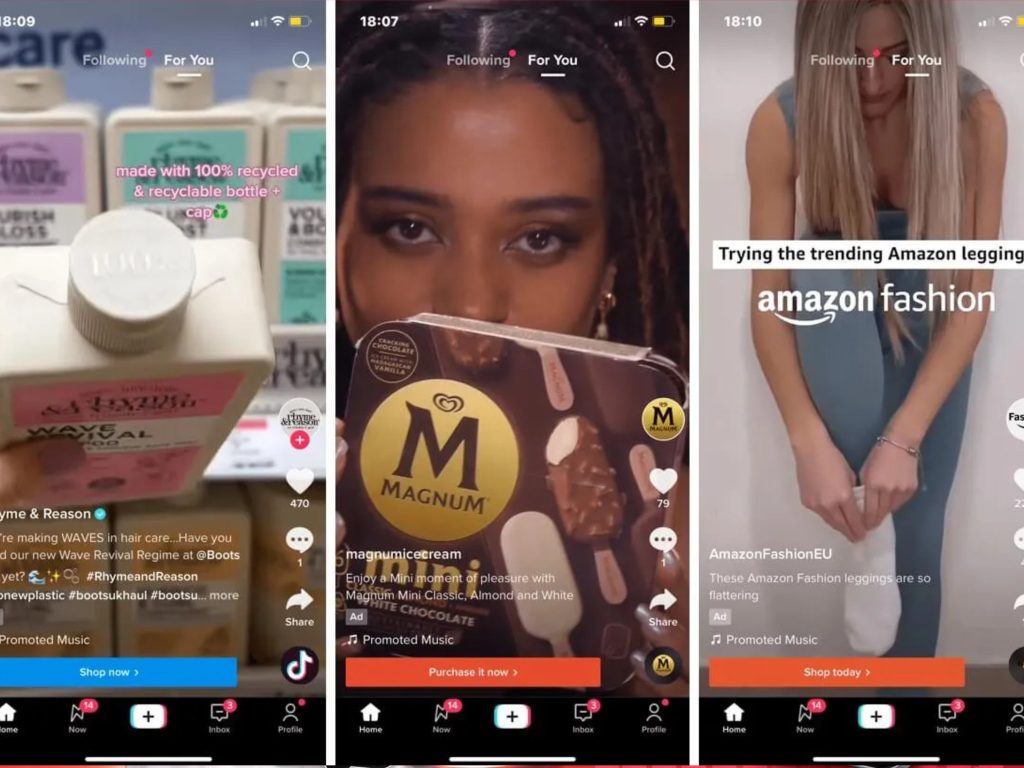
Through TikTok Ads Manager, advertisers can create campaigns, select audiences, set budgets, direct users to a website, app, or TikTok Shop, track conversions, and run remarketing campaigns.
How Is TikTok Promote Different from TikTok Ads Manager?
Promote is a simple promotional tool available within the TikTok app. Users can select an existing video, choose a basic objective and audience, and set the campaign duration and budget. This tool is suitable for increasing views, followers, profile visits, or website traffic.
TikTok Ads Manager provides more advanced control. Businesses can manage multiple campaigns, optimize for conversion events, create audience segments, use TikTok Pixel and Events API, and track CPA, ROAS, and revenue.
If the objective is to generate leads or orders or build a long-term advertising system, Ads Manager is generally more suitable.
Common TikTok Advertising Objectives
Paid media should support a broader TikTok marketing strategy rather than operate as an isolated activity. The campaign objective should therefore be selected according to the role advertising plays in the overall customer journey.
The names of objectives and available features may vary depending on the market or account type, but they usually fall into four main categories.
Brand awareness
This objective is suitable when a business wants to reach a large audience, introduce a new product, or increase brand visibility. Common metrics include reach, impressions, CPM, frequency, and video views.
Traffic and engagement
The Traffic objective directs users to a website, landing page, product page, or app. However, inexpensive clicks do not necessarily indicate high-quality customers. If the final objective is a form submission or purchase, businesses must also track the actions users take after clicking.
Lead generation
The lead generation objective is suitable when a business needs to collect customer information, consultation requests, or program registrations. Forms should be concise and clearly explain what users will receive after submitting them.
Sales and app promotion
The Sales objective is used to drive conversions on a website, app, or TikTok Shop. For apps, businesses can optimize for installations or in-app actions, but this usually requires an SDK or another suitable measurement solution.
The important point is to choose an objective based on the desired final action. If a business wants orders but selects Traffic only because the CPC is lower, the system may prioritize users who are likely to click rather than those who are likely to buy.
Types of TikTok Ads
In-Feed Ads
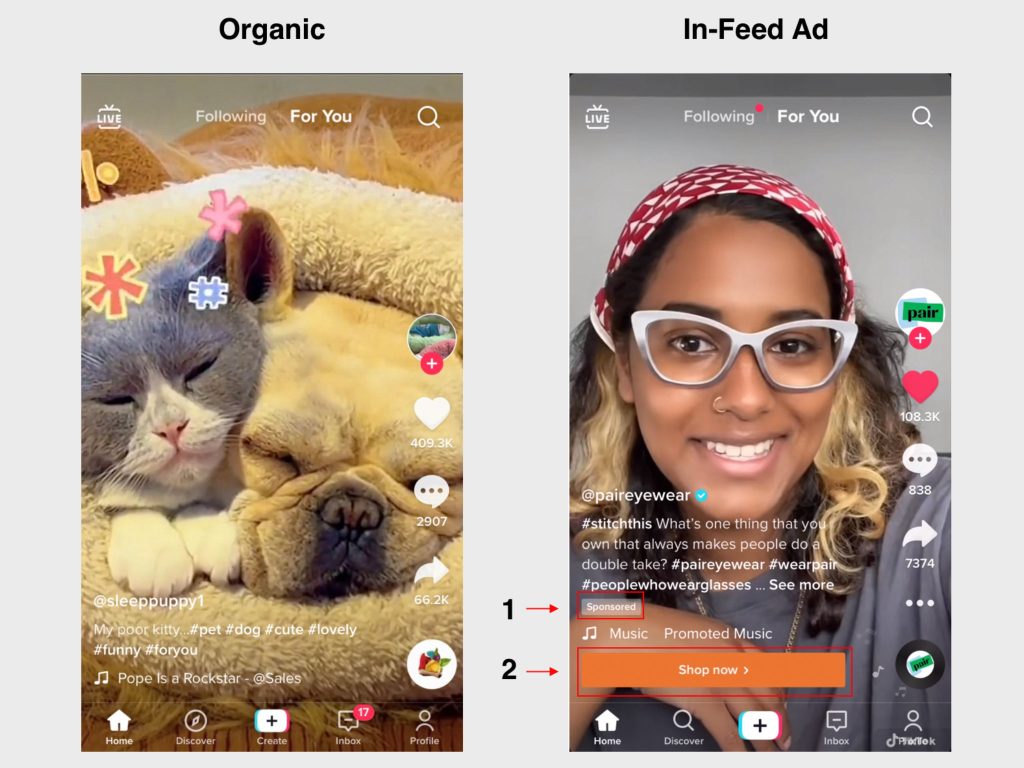
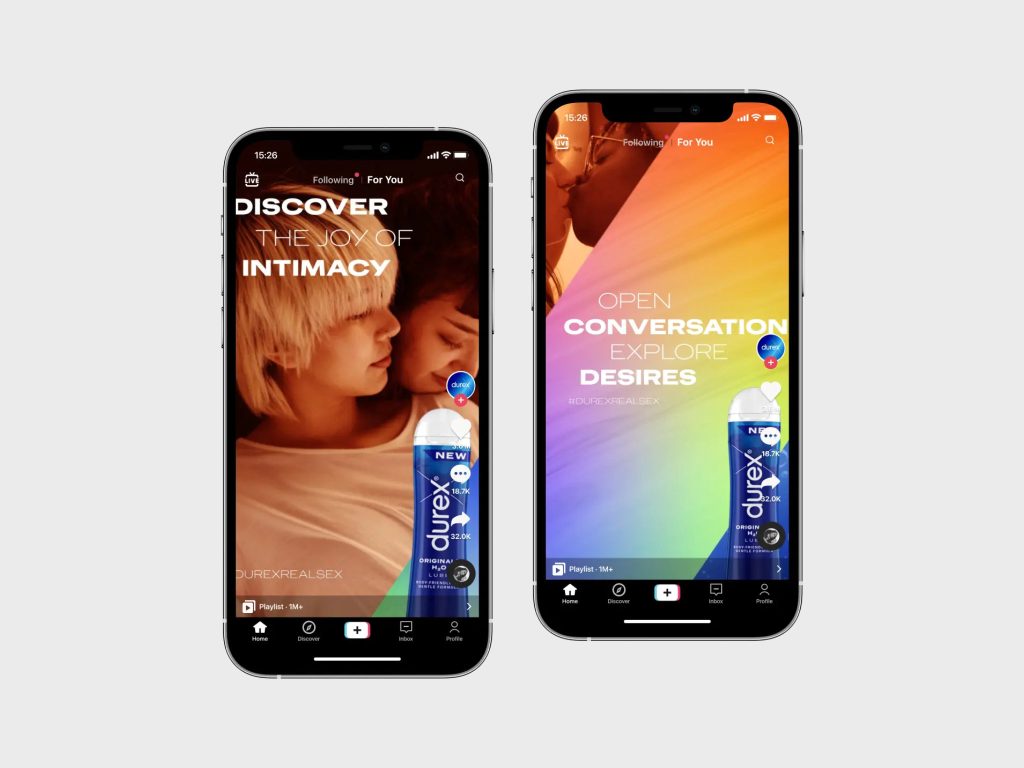
In-Feed Ads appear within the content feed and resemble regular TikTok videos. These ads may include a vertical video, caption, CTA, and link to a website, app, or product.
Spark Ads
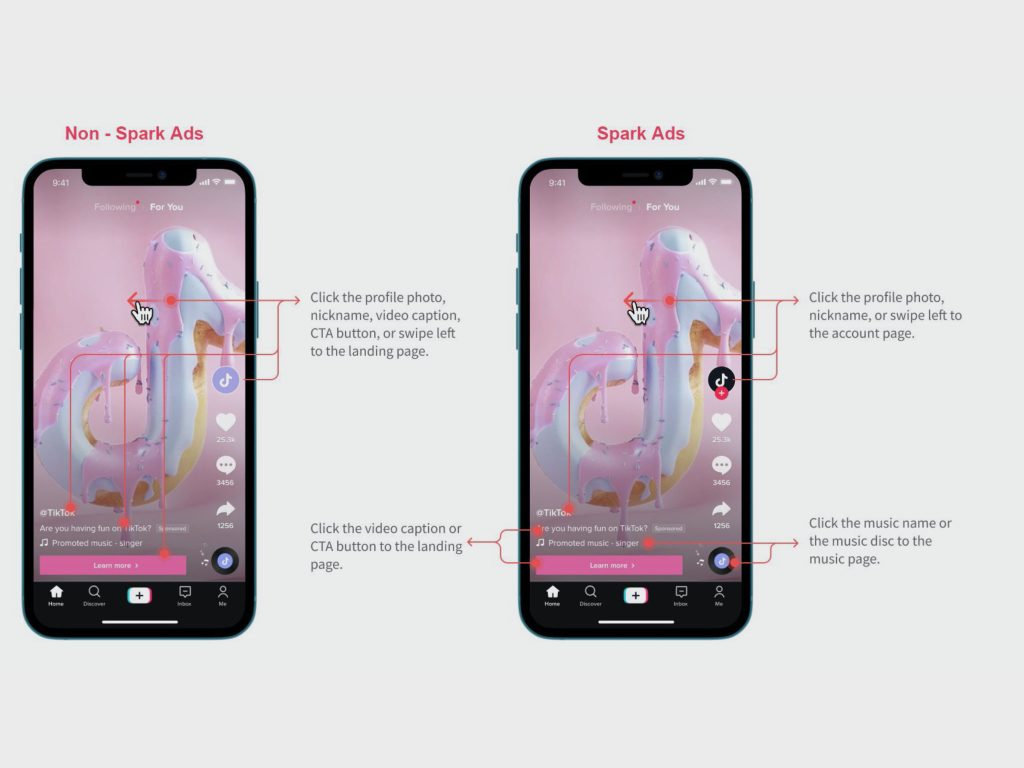
Spark Ads allows businesses to promote organic videos from their own brand account or from creators who have granted authorization. Viewers can still like, comment on, and share the video, visit the profile, and follow the account.
This format is suitable when an organic video has already shown positive signals or when a business wants to use natural content created by creators or KOCs.
Search Ads and TikTok Shop Ads
Search Ads reaches users who are searching for keywords related to a product or service. This format is suitable for clearly defined demand, such as reviews, comparisons, or specialist solutions.
Sellers may also use TikTok Shop advertising solutions or GMV Max, depending on which features are available for their accounts.
Beginners should generally start with In-Feed Ads or Spark Ads because they are easier to test and measure.
TikTok Ads Campaign Structure
TikTok Ads Manager generally uses a three-level structure:
- Campaign: Defines the advertising objective and overall campaign settings.
- Ad Group: Determines the destination, optimization event, audience, placement, budget, and schedule.
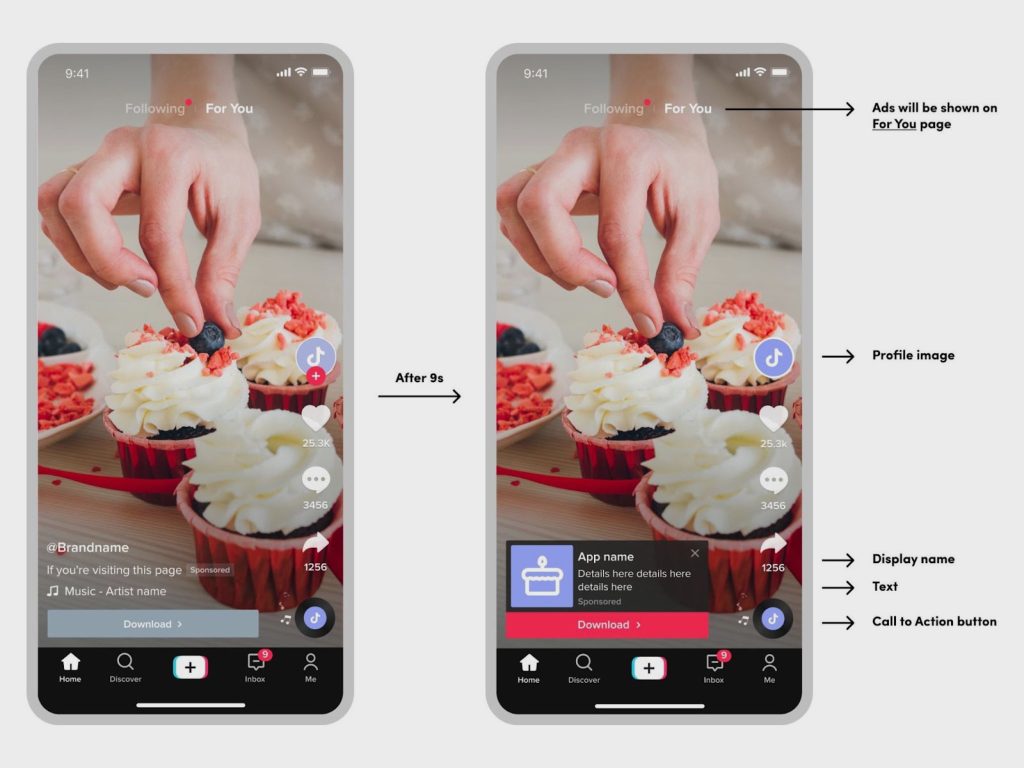
- Ad: Contains the video, caption, CTA, URL, and displayed account.
This structure allows businesses to separate objectives, audiences, and creative assets so that performance can be analyzed more clearly.
What Should You Prepare Before Running Ads?
Account and business information
When creating an Ads Manager account, carefully check the country, time zone, currency, website, and payment method. Business information should be consistent with the website and legal documents.
Businesses should also have a branded TikTok account if they want to build a profile, run Spark Ads, and combine organic content with paid media.
Website or landing page
The landing page should load properly on mobile devices, match the advertising message, and contain a clear CTA. Product information, pricing, policies, and contact details should be complete.
If an advertisement promotes a specific offer but sends users to a generic homepage, the conversion rate may decline.
TikTok Pixel and Events API
TikTok Pixel records events through the browser. Events API shares data through a server connection. Businesses can use both to improve data completeness and support campaign optimization.
Common events include ViewContent, Contact, SubmitForm, AddToCart, InitiateCheckout, and Purchase. Before launching a campaign, check the order value, currency, and event deduplication mechanism.
Multiple advertising creatives
Do not prepare only one video. Test several TikTok content formats, including demonstrations, problem-solving videos, reviews, and creator content.
An initial testing set may also include several hooks, content angles, and versions with different durations. Preparing multiple creatives helps businesses determine whether performance differences come from the audience, message, format, or opening.
A Beginner’s Guide to Running TikTok Ads
Step 1: Create an Ads Manager account
Enter complete information, including an email address or phone number, business name, country, time zone, currency, website, and payment method. Check that all information is consistent before submitting it to reduce verification issues.
Step 2: Select the objective and conversion destination
Begin with the desired final action:
- To increase visibility, select an awareness objective.
- To direct users to a website, consider Traffic.
- To collect form submissions, select Lead Generation.
- To generate orders, select Sales with the appropriate destination.
- To sell through TikTok Shop, use the currently available Shop Ads or GMV Max solution.
The objective determines how TikTok identifies users to whom it should distribute the advertisement.
Step 3: Select the optimization event
For a new website with limited data, a business may initially optimize for an event in the middle of the customer journey. Once sufficient data is available, it should optimize for an event closer to revenue, such as Purchase.
Service businesses may select SubmitForm or Contact. Do not assume that optimizing for clicks will automatically generate conversions.
Step 4: Define the audience
TikTok Ads may allow targeting by location, language, age, interests, behavior, device, Custom Audience, or Lookalike Audience.
Beginners often target too broadly when the content is not capable of filtering the audience effectively, or too narrowly, causing the ad group to lack sufficient data. Businesses can test several groups based on clear hypotheses, such as broad targeting, interest targeting, and remarketing.
Avoid dividing a small budget across too many groups.
Step 5: Set placements, budget, and bidding
In many cases, automatic placements give the system more opportunities to optimize. Placements should only be restricted when there are clear legal, brand, or data-based requirements.
The budget should be sufficient for the ads to receive distribution and collect data. There is no universal budget that works for every industry. Treat the initial budget as a testing cost rather than a guaranteed investment return.
Step 6: Create and review the advertisement
The video should use the correct aspect ratio, on-screen text should not be covered by the interface, the audio must be properly licensed, and the CTA should be appropriate. The URL, landing page, tracking parameters, and Spark Ads authorization should be checked before submission.
Step 7: Submit the campaign for review and monitor it
Once the campaign is active, avoid making continuous changes simply because it has not generated an order within the first few hours. Monitor delivery, CPM, CTR, CPC, Landing Page Views, conversion rate, CPA, revenue, ROAS, and lead quality.
How to Create Effective TikTok Advertising Videos
Open directly
The first three seconds should tell viewers who the video is for, which problem it addresses, and why they should continue watching.
For example:
If your sales video receives clicks but no orders, check this mistake.
Use a style that suits TikTok
Content often feels more natural when it uses vertical video, authentic visuals, a clear pace, easy-to-hear audio, real actions, and concise text. Avoid uploading a traditional television commercial directly to TikTok and expecting strong performance.

Begin with the customer’s problem
Instead of opening with a list of features, begin with a usage situation:
This solution is designed for people who film videos alone but spend too much time adjusting the camera angle.
The product can then be introduced as the answer to that need.
Provide evidence and a clear CTA
Evidence may include a demonstration, before-and-after results, customer feedback, a comparison, or a real process. The CTA should request only one primary action, such as viewing the product, visiting the website, completing a form, or registering for a consultation.
Metrics You Need to Understand
| Metric | Meaning |
| Impressions | The number of times the advertisement is displayed |
| Reach | The number of people reached |
| CPM | The cost per 1,000 impressions |
| CTR | The percentage of impressions that generate a click |
| CPC | The average cost per click |
| CVR | The conversion rate |
| CPA | The cost per conversion |
| AOV | The average order value |
| ROAS | Revenue generated relative to advertising expenditure |
| Frequency | The average number of times one person sees the advertisement |
Metrics should not be interpreted separately. A low CTR may indicate a weak hook. A high CTR combined with a low CVR may indicate a problem with the landing page, price, or audience. CPA may increase while ROAS remains strong if the average order value is high.
How to Diagnose and Optimize a Campaign
The advertisement is not being delivered
Check the review status, budget, bid, audience size, schedule, Pixel, optimization event, and landing page validity.
CPM is high or CTR is low
A high CPM may be related to a competitive audience, narrow targeting, peak advertising periods, or high frequency. A low CTR is often related to the first three seconds, the main benefit, product visuals, or audience relevance.
The campaign receives clicks but no conversions
Check the page speed, mobile experience, consistency between the video and landing page, pricing, shipping fees, forms, checkout process, and traffic quality.
The campaign generates orders but no profit
Businesses must also calculate the cost of goods, platform fees, shipping, returns, Affiliate commissions, content production, and personnel. ROAS does not always reflect actual profit.
A Testing Structure for Beginners
An initial test should have one clear objective, several audience groups based on defined hypotheses, multiple videos, and one consistent conversion destination.
For example, a business could test three hooks, two content angles, one creator video, one demonstration, and one review. Avoid changing the targeting, video, budget, and landing page simultaneously because this makes it difficult to identify what caused the difference.
Do not stop an advertisement after only a few hours unless there is a clear problem. However, maintain controls so that creatives with extremely weak metrics do not continue consuming the budget for too long.
Common Mistakes
Common mistakes include running advertisements before testing the content, selecting Traffic when the actual objective is orders, preparing only one video, targeting too narrowly, and failing to install tracking.
Some businesses evaluate campaigns only through CTR, change too many variables at once, or fail to assess lead quality. Competitor formats may be used as references, but the message and supporting evidence must be based on the actual product.
TikTok Ads helps businesses expand their reach and generate traffic, leads, or sales. However, results do not come from simply increasing the budget. Beginners need to start with the business objective, conversion point, and measurement system.
They should then develop multiple videos suited to TikTok, select audiences based on clear hypotheses, and evaluate the entire journey from impressions to revenue. By continuously testing content, audiences, and landing pages based on data, TikTok Ads can become a measurable growth channel that can be optimized over the long term.
Read next: Running ads for products sold directly on TikTok? Learn how to connect paid campaigns with your broader TikTok Shop Marketing system, including product pages, organic videos, creators, and LIVE sessions.